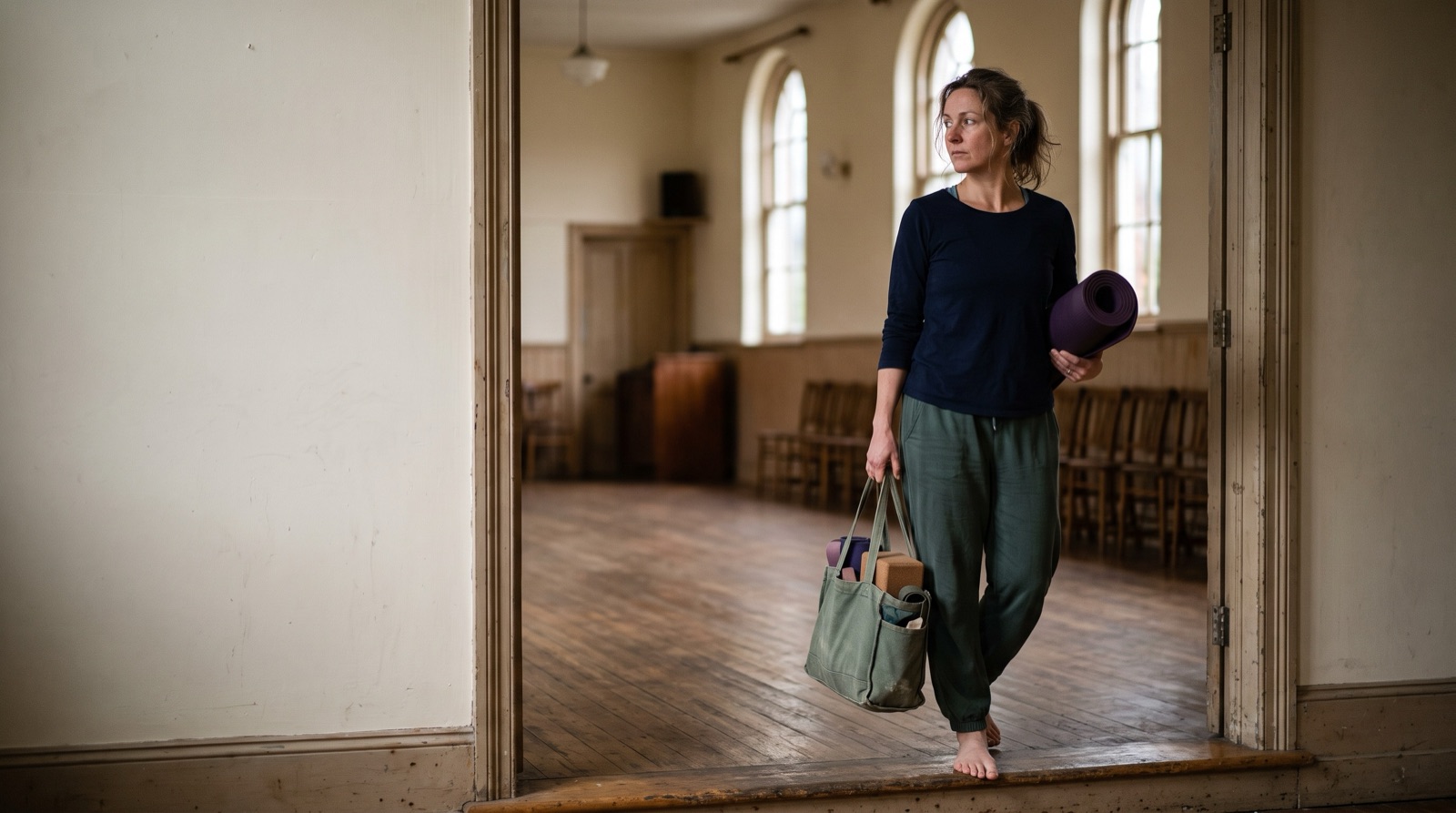
- Five conditions sit under every teaching career: students leave, class numbers rise and fall, studios close, timetables change, and some classes simply don’t land.
- None of the five is a verdict on you. Most run on things you never controlled, and you’ll rarely be told the real reason.
- These are conditions of the work, the way weather is a condition of farming. Nobody thinks the farmer caused the rain.
- Yoga and Stoicism teach the same distinction: you have a claim on your effort, and none on its results.
- Sorting what’s yours from what never was won’t keep studios open. It changes what a closure costs you, and puts your effort where it still moves something.
Five facts come with a teaching career, and you can count on all of them: students leave, class numbers rise and fall, studios close, your timetable changes under you, and some classes just don’t land. None of the five is a verdict on you. Most of it runs on things you never held in the first place. Expect the five, sort what’s actually yours, and each one costs you less.
By YogaPros — the professional body for yoga teachers since 2006, with more than 10,000 members across 100+ countries.
What are the five facts of a teaching life?
Five conditions sit under every teaching career. Read them together and the grip of any single one loosens.
- Students leave. Even the ones who told you the class saved their week. Shifts change, babies arrive, knees pack in, families move. Most of it has nothing to do with you, and you’ll almost never hear the real reason.
- Rooms fill and empty. January turns up full of resolutions; August clears out for the holidays. The numbers move with term dates and the weather.
- Studios close. That call gets made in a spreadsheet you’ll never see, sometimes by someone who never once took your class.
- The timetable you built shifts under you. Cover cancels at five. The retreat doesn’t fill. The hall gets double-booked for a kids’ party.
- Some classes don’t land. You prepared well and taught well, and the room stayed flat regardless. A year of teaching hands you at least one of those nights.
Line them up and they stop reading as failures. They read as weather. These are conditions of the work, the way rain is a condition of farming. Nobody blames the farmer for the rain.
Why isn’t a closing studio a verdict on me?
Because it gets decided in a spreadsheet you never see, for reasons that were rarely about your teaching.
Say the message comes on a Tuesday, somewhere between the school run and your evening class. The studio’s closing at the end of the month. Six years of Thursday nights, done in two lines and a sad-face emoji. You know the spiral that starts here. Maybe the numbers were my fault. Maybe I should have pushed the class harder. By ten o’clock a closing studio has turned into a referendum on you, and you’re awake questioning the whole career. But the rent, the footfall, the landlord’s plans, the lease: none of it was ever in your hands. The spiral runs on one confusion. It reads a condition of the work as a report card, and it isn’t one.
How do I handle the parts I can’t control?
With a distinction that’s older than any of us. Your effort is yours to give. How it turns out was never in the contract.
Yoga got there first. The line people quote most from the Bhagavad Gita says exactly that: a claim on the effort, none on the fruit. Teach the class as well as it can be taught. The size of the room was never yours to promise. If your results run through other people, that reads less like philosophy and more like a job description.
The Stoics landed in the same place. Epictetus opened his handbook nearly two thousand years ago by sorting everything into two piles: what’s up to us, and what isn’t. Your judgement and your effort go in the first pile. Other people and outcomes go in the second. Peace, he said, comes from working the first pile and leaving the second alone.
And the modern research on acceptance keeps backing the old instruction. People who burn their energy fighting a fact they can’t change tend to carry the stress longer and act later. People who accept the fact and turn to what’s left recover sooner. Acceptance gets mistaken for giving up. Up close it’s closer to accuracy: an honest read of where your effort still works, so all of it goes there.
How do I sort what’s actually mine?
On the night something goes wrong, put it on one page and split it into two short lists. Ten minutes, no more.
Write what happened in one plain line, no interpretation: “The studio closes on the 31st.” Under it, two lists, one after the other, headed Mine and Not mine. Not mine: the studio’s rent, the student’s new shift, the kids’ party, August itself. Mine: how I prepare, how I answer the email, whether my insurance is current and my agreements are in writing, whether I ask the owner for a reference before the doors shut, where the class could move next.
Then act once, small, off the Mine list. One message, sent before bed. Read the Not-mine list and leave it be. Watch where the spiral wants to move in, because nearly everything it wants to chew sits on that second list. Which is the whole reason chewing never turns into an action. The sort won’t keep a studio open. It changes what the closure costs you, and it puts your effort where effort still shifts something.
Where does a professional body come in?
When the Not-mine list holds a closing studio or cancelled cover, the floor under you decides what the week actually costs.
Current insurance and agreements in writing aren’t the romantic part of a teaching life. They’re the part that turns a bad month into an inconvenience instead of a crisis. Holding that floor steady is a fair share of what a professional body is for. We keep the parts of a teaching life that shouldn’t rest on any one teacher’s memory or good luck, so that when one of the five facts lands, you’re not also scrambling for cover you assumed was there. The sort tells you what’s yours. The floor holds the rest.
Members go deeper. YogaPros members can read the full version of this in the Learning Hub, with a one-page card to print for the five facts and the Mine / Not-mine sort. It sits in the Wellbeing & Mindset collection: practical support for the working life of a yoga teacher, including the unglamorous floor that decides what a bad week costs.