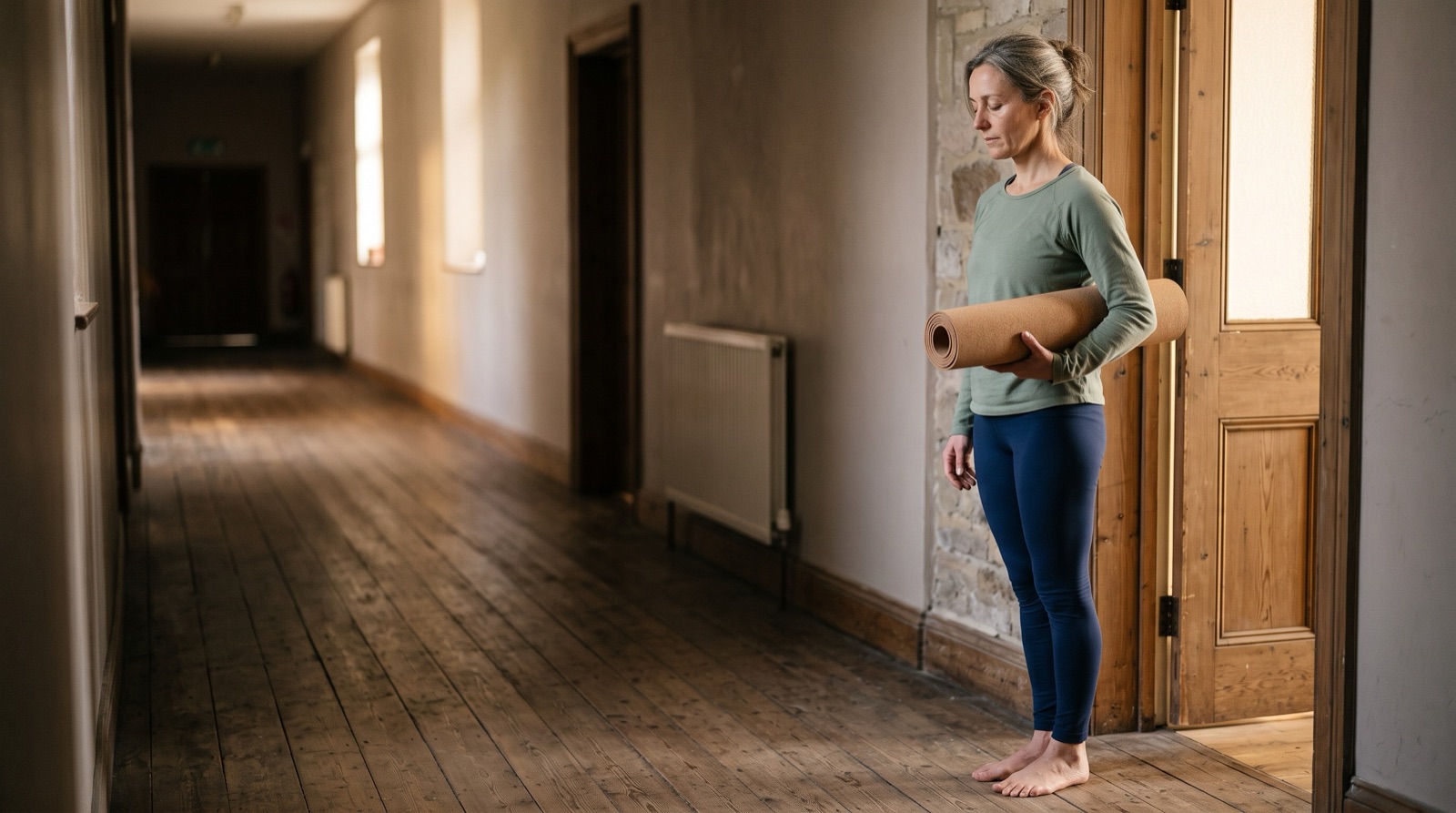
- The state you carry through the door sets the tone of a class’s first ten minutes more than your plan does.
- A two-minute settle before you walk in draws a clean line between the day you’ve had and the teaching.
- The practice is yoga’s own: a still body, an exhale longer than the inhale, and one chosen point of attention.
- Research on slow-paced breathing finds a longer exhale steadies the nervous system within a couple of minutes, strongest at around six breaths a minute.
- No time? Shrink it to three long exhales and one point of attention, about thirty seconds. Just don’t skip it.
- Your own steadiness is working equipment. Looking after it is part of the job, not a nicety.
The steadiest way to calm your nerves before teaching is to settle your own body and breath for two minutes before you walk in. Stand until your weight evens out. Lengthen the exhale past the inhale for about a minute. Then pick one point of attention to hold while the room fills. It’s the settle YogaPros teaches its members for this exact gap.
By YogaPros — the professional body for yoga teachers since 2006, with more than 10,000 members across 100+ countries.
Why do the minutes before class matter so much?
There’s a gap nobody puts on the schedule. It sits between arriving as yourself and standing up as the teacher, and most evenings you cross it still wearing the day like a coat you forgot to take off. The school run, or the day job. A drive that took longer than it had any right to. The room to unlock, the heating doing something of its own, someone already by the door wanting a word about their knee. And on the hour, you’re meant to be the calmest person in the building.
Whatever state you carry across that gap walks in with you, and it teaches the first ten minutes far more than the sequence does. The nerves aren’t a flaw in you. They’re what happens when nothing marks the line between the day behind you and the hour in front. You’ve been handing your students the tools for exactly this for years. Two minutes is keeping a little of it back for yourself.
Isn’t this just the yoga I already teach?
Yes, and that’s the point. Settling the body to settle the mind is the working premise of asana. Pranayama goes further, steadying the nervous system through the breath. And dharana, resting attention on one chosen point, is half of what people come to class for whether they’d name it or not. None of it came from the wellness industry. It’s the profession’s own inheritance, and the odd part is how rarely teachers turn any of it on themselves on a working evening.
The teacher’s own state was never an afterthought in that tradition either. You steady yourself first, then you teach. Somewhere between training and a full timetable, the order gets lost.
The research base agrees with the old texts, most clearly on the breath. Studies of slow-paced breathing find that when the exhale runs longer than the inhale, heart rate steadies and the body eases out of its alert state within a couple of minutes. A pace of around six breaths a minute keeps coming up as the point where that effect is strongest. You watch it happen in other people every time you close a class. And it works just as well standing in a corridor with your coat still on.
What are the two minutes, step by step?
Do it somewhere you won’t be interrupted, before you walk in rather than while you’re greeting people. The car works. So does the quiet end of a corridor. The point is a clean line between the day and the teaching.
- Body, about thirty seconds. Stand still, feet flat, and let your weight come even. Shoulders down. Jaw loose. You’re not stretching or demonstrating anything. You’re arriving all the way.
- Breath, about a minute. In through the nose for a count of four, out for six, eight to ten rounds. If counting feels fussy on a Tuesday, just let every out-breath run longer than the in-breath and allow the pace to slow on its own.
- Attention, the last stretch. Choose one thing to walk in holding: the first sentence you’ll say, or one student you’ll greet by name. In the tradition you might call it a sankalpa, an intention set on purpose. On a wet November evening it can be as plain as the word slow. One point, so your mind has somewhere to stand while the room fills.
What if there’s genuinely no time?
Shrink it. Don’t skip it. When the six o’clock runs over and the six-fifteen is already arriving, three long exhales and one chosen point of attention take about thirty seconds. Thirty seconds done on purpose does more than you’d expect.
Two minutes will not repair a hard day, and it doesn’t need to. The job is smaller than that. The class gets the teacher, and the traffic stays out in the car park.
How do I make it a habit?
Anchor it to something that already happens, so it doesn’t need remembering. After the room is set up, or the moment your phone goes on silent, let that be the cue to step aside and run the sequence. Choose your point of attention before you leave the house rather than in the car park, when the day is loud and choosing is harder.
Then give it a fortnight and watch the first ten minutes of your classes. That’s where it shows up first, well before you feel it anywhere else. The opening settles, the room takes its cue from that, and the evening starts from steadier ground.
Is settling before class a professional matter, or just a nicety?
It sits on the professional side of the work. Your own steadiness is part of the equipment you teach with, the same as your voice or your hands, and the professions that last treat looking after your equipment as ordinary upkeep. A teacher who arrives settled is teaching to a standard. Not performing calm.
So take the two minutes before your next class, and hang the day up outside the door. Let the room have the teacher rather than the traffic. That’s the frame YogaPros holds with its members: professional standards that assume a teacher who looks after their own state as well as their students’. Settling before you teach sits in that column.
Members go deeper. YogaPros members can read the fuller version of this piece in the Learning Hub, with a one-page card for the two-minute settle to keep in a teaching bag. It’s part of the Wellbeing & Mindset collection: practical support for the working life of a yoga teacher, not the performance of calm.